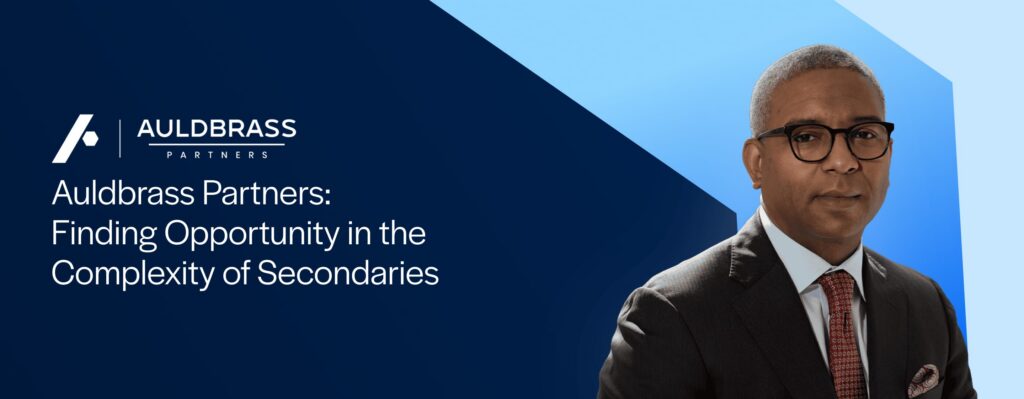
Howard Sanders’ early years were shaped by a push to pursue paths others hadn’t yet fully opened. His father owned radio stations, while his mother encouraged him to look beyond conventional choices. “I really wanted to do something different,” Sanders recalls. “Not entertainment or media, but finance.” After graduating from Wharton, as Black professionals were working to establish a foothold on Wall Street, he gravitated toward an industry defined by access, rigor, and consequence.
That instinct — to engage with complex, underexplored parts of the market where judgment matters most — would come to define Sanders’ career. Over time, it shaped both his investment philosophy and the kind of platform he set out to build, ultimately leading to the founding of Auldbrass Partners.
Founded in 2011 as a spin-out from Citigroup, Auldbrass Partners is a 100% employee-owned private equity firm specializing exclusively in secondaries. As Managing Director, Sanders helps oversee the firm, which invests in concentrated fund positions in high-quality private companies with durable growth, strong fundamentals, and a clear path to liquidity—typically within three to five years.
Secondaries at Scale
Auldbrass executes its strategy through both LP and GP-led secondary transactions across middle-market and global buyout and growth equity funds, bringing deep experience to complex structures such as fund restructurings and SPVs. Across their careers, Auldbrass principals — which includes Managing Director Christopher Salley — have completed more than $3.8 billion in secondary transactions, partnering exclusively with institutional-quality managers that provide transparent, reliable portfolio data.
The firm’s approach aligns with the broader evolution of the secondary market. According to “2025 Secondary Market Highlights,” a report by global investment banker Evercore, annual secondary transaction volume surpassed $200 billion for the first time, reflecting both the market’s growing scale and its increasing strategic importance within private capital. Evercore cited sustained liquidity needs, continued innovation in deal structures, and more advanced use of data and technology in portfolio analysis, pricing, and execution as key drivers of improved market efficiency.
At a time when private equity is contending with stalled exits, inflated valuations, and a mounting liquidity backlog, these dynamics have positioned secondaries as a critical pressure valve for both GPs and LPs. Evercore noted that growth in 2025 extended beyond buyouts, with record activity in private credit secondaries and continued expansion across infrastructure and venture strategies. While capital availability entering 2026 is more constrained, fundraising targets remain at all-time highs—reinforcing the momentum behind the market’s next phase and the relevance of Auldbrass’ disciplined, structure-driven approach.
A Deliberate Path to Secondaries
Sanders’ path to private equity secondaries wasn’t linear—but it was intentional. From public finance and investment banking to building and selling a middle market business, each chapter sharpened his focus on discipline, control, and downside protection. “I’ve always been drawn to businesses in the middle market,” he says, “but investment discretion is most important for me.” That mindset, shaped by experience across multiple cycles, would later define Auldbrass Partners as a firm built to engage with complexity, rather than sidestep it.
Raised in New York, Sanders moved from Wharton to early roles at JPMorgan Chase before joining the Massachusetts state government, where he worked on complex public finance transactions during a period of fiscal repair. “Coming up with creative financings was part of that,” he recalls. The experience—combining structured problem-solving with real-world consequence—helped cement an approach grounded in pragmatism and fundamentals, not financial theory alone.
After graduating from Wharton, there was a broader push among Black professionals to break into finance, even as the most coveted corners of private equity remained largely inaccessible. “Everyone wanted to go into private equity,” he says, but direct buyout roles were rarely available. At the time, firms like KKR and Blackstone had no Black partners—a reality that underscored how narrow the path truly was.
Secondaries presented an opportunity that Black and Latino professionals were well-positioned to take advantage of. Over time, secondaries emerged as a space where representation modestly outpaced direct private equity, despite being a far smaller segment of the market. For Sanders, that dynamic reinforced both the appeal of secondaries and the opportunity to build expertise in areas others overlooked, laying the groundwork for Auldbrass and a career defined by navigating the industry from the margins inward.
Laying the Foundation
After Harvard Business School, a stint in investment banking at Lehman Brothers, and Deutsche Bank, Sanders took an entrepreneurial detour. He bought and grew a legal publishing business before selling it to a global publisher, reinforcing a hands-on ownership mindset that emphasized cash flow, operational clarity, and accountability. That perspective ultimately drew him back to Citigroup, where he moved into alternative investments and began executing secondary transactions as the market was still taking shape.
The global financial crisis proved defining. Sanders was tapped to help unwind alternative assets under the Volcker Rule. Working alongside Mark Mason, then COO of Citi’s “bad bank,” Sanders led or co-led billions of dollars in secondary transactions. “To work at the bank and co-lead that new effort,” he says, “was a fantastic opportunity.”
That experience led directly to Auldbrass’ launch in 2011, when Ardian acquired a $1.7 billion portfolio from Citi and proposed spinning out the team to manage it. With a built-in advisory role across roughly 250 funds, Auldbrass was born as a specialist from day one. Partner Chris Salley, his classmate and friend from Wharton undergrad, joined in 2012, and the firm has remained intentionally focused on disciplined underwriting, transparency, and secondaries as a core strategy rather than an opportunistic add-on.
A Perfect Storm for Secondaries
By 2025, private equity secondaries had crossed a symbolic threshold: over $200 billion in transaction volume, a banner year that underscored how far the market had come.
The appeal of secondaries has deepened as the market evolved. From 2017 through 2019, low rates, rapid exits, and surging distributions fueled larger funds and a shift in institutional behavior. LPs increasingly sold older, mature exposures to double down on newer, brand-name platforms. Sanders and his team leaned into the moment—but selectively. They focused on asset-light businesses where leverage wouldn’t derail returns late in the holding period. “If you’re in year five or six and heavily levered,” he explains, “you suddenly find yourself in a cash crunch.” Software, healthcare, and select services became core areas of focus—industries with durable growth and operating flexibility.
Then came the hangover. Valuations spiked in 2021 and early 2022, especially in technology, and exits stalled. GPs were reluctant to sell assets at reduced prices, particularly as GP-stakes investing and continuation vehicles reshaped incentives. The result was a growing liquidity backlog—and a quiet capitulation among LPs. “The only way I’m going to get liquidity is to sell at a discount,” became the prevailing view. In Sanders’ eyes, this convergence—overvaluation, delayed exits, GP consolidation, and LP pressure—created a near-perfect storm. It also reinforced why secondaries, once a niche, had become indispensable to the private market ecosystem.
Searching for Equilibrium
Sanders is careful not to overstate what anyone can truly know during a market cycle. “Hindsight is 20/20,” he says. “But when you’re in it, you really don’t know where it’s headed.” While headlines suggest liquidity is returning—fueled by high-profile media and technology transactions—Sanders cautions that those signals overstate the recovery. In a normal year, global M&A activity reaches roughly $3.5-$4 trillion; today’s volume remains well below that threshold, particularly for private equity–led transactions.
Funds raised between 2019 and 2023 are largely holding assets, reluctant to sell at valuations that no longer reflect the markups of 2021 and early 2022. Liquidity is instead coming from older vintages—especially 2015 to 2019—along with strategic buyers and selective AI-driven activity. As a result, Sanders is skeptical that 2026 will deliver a broad-based liquidity rebound. “It’s very hard to say that 2026 will be a year of increased liquidity,” he says, pointing to persistent valuation gaps and uneven exit activity.
That uncertainty is shaping how Auldbrass operates today. After a surge in secondary volume, Sanders expects the market to flatten or pull back modestly as it absorbs larger fund sizes and heightened competition. “It’ll lurch forward, drop back, and then work its way up,” he says. For Auldbrass, the response has been to slow the pace and sharpen focus.

“We’re taking smaller bites, emphasizing selectivity over scale in an environment where leverage, not conviction, often drives pricing.”
– Howard Sanders, Founder & Managing Director
Discipline Over Momentum
Increasingly, Sanders says Auldbrass is leaning into capital formation deals—situations in which capital is deployed to create value rather than simply change hands. These investments often support strategic initiatives, such as mergers, operational reinvestment, or leadership transitions, that extend the runway and improve exit outcomes. In one recent example, Auldbrass invested directly into a healthcare technology company’s balance sheet, backing a management reset and product reinvestment. Although the business ultimately sold below expectations, Auldbrass’ structured position still delivered a preferred return of 1.5x.
That approach reflects a broader industry reality. Despite a record year for secondaries—roughly $225 billion to $250 billion in volume—liquidity across private equity remains constrained. Fundraising is difficult, exits are delayed, and many GPs are reluctant to sell portfolio companies when management fees provide stability during a downturn. As a result, secondaries have become the primary mechanism for liquidity, whether through traditional LP interest sales or GP-led continuation vehicles, which now represent a substantial share of market activity.
Looking ahead, Sanders sees opportunity precisely in that dislocation. Auldbrass is increasingly focused on structured, credit-oriented secondary solutions in the lower middle market—transactions designed to protect downside while preserving upside. That includes capital-formation deals, NAV-based solutions, and structured continuation vehicles, particularly when assets have already been recapitalized or face valuation pressure. In an uncertain market, Sanders says, discipline, diversification, and structure matter more than ever – guiding the firm toward strategies built not just to weather the cycle, but to compound through it.